45.528543, 13.568429


Urban theatre
Piran
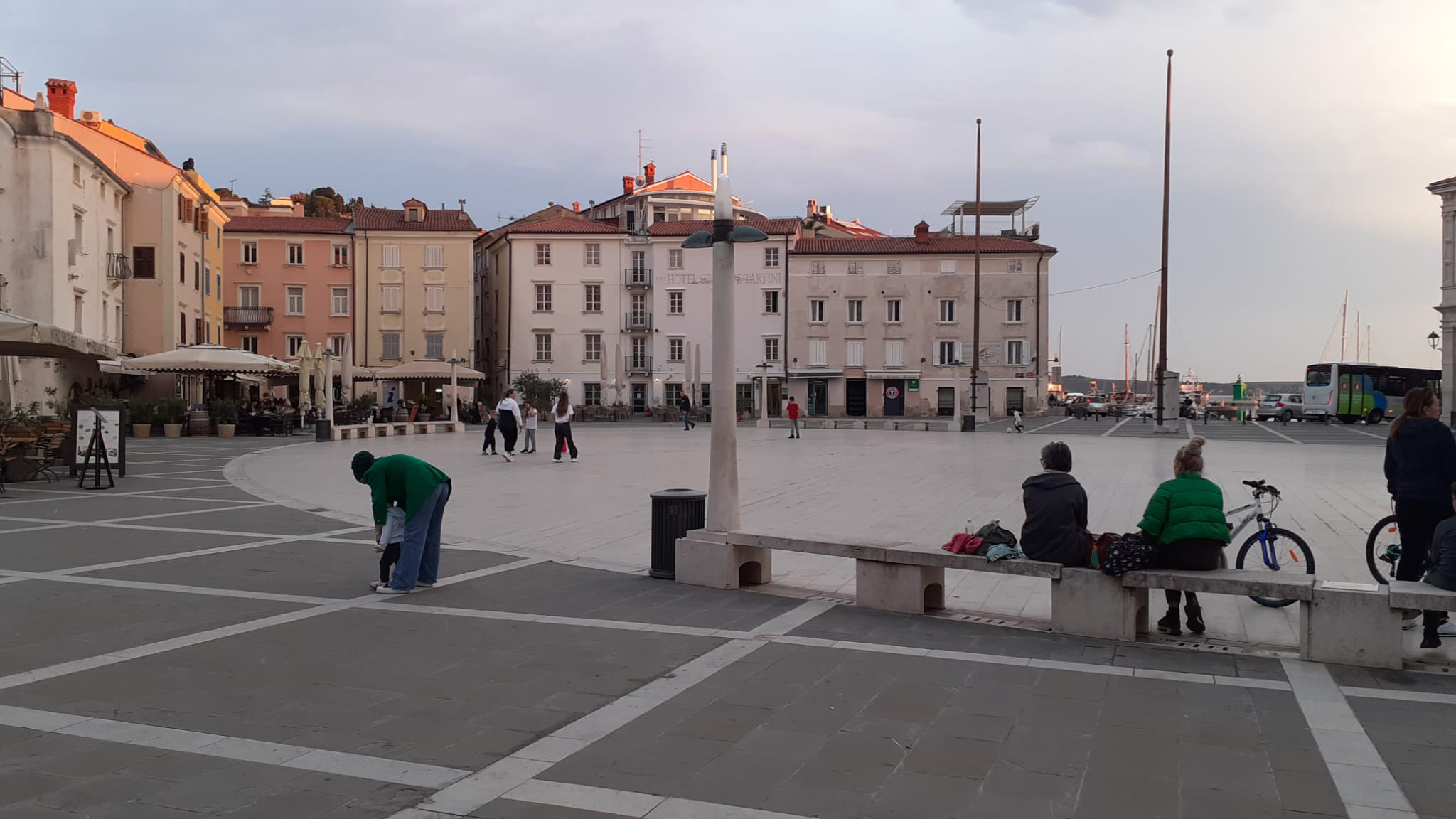
In The Concise Townscape (1961), Gordon Cullen understands public space as a place shaped through the relationship between centre, edge, movement, and perception. Tartini Square appears as an enclosed civic stage defined by the continuous façades surrounding it, while remaining visually open toward the sea and the horizon line. The contrast between the dense architectural border and the expansive paved surface creates what Cullen describes as “exposure and enclosure” — a spatial tension that gives emotional character to urban space.
People crossing the open centre of the square appear exposed within the large civic void, while others seated along the perimeter occupy positions of observation and retreat. The benches along the edge act as thresholds between participation and spectatorship, turning the square into what Cullen might describe as a “drama of juxtaposition.” The open pavement becomes a field of movement and encounter, while the architectural edges provide containment, orientation, and visual continuity.
The spatial arrangement of the square heightens the observer’s awareness of position within the environment. From the foreground benches to the distant harbour edge, the viewer experiences depth, direction, and orientation through the positioning of bodies and built elements. The paving lines guide movement across the square toward the waterfront, while the vertical poles and surrounding façades establish rhythm and spatial order.
The foreground seating area establishes the “Here” of pause and observation, while the harbour and maritime horizon form the distant “There” toward which the space opens.