45.528543, 13.568429
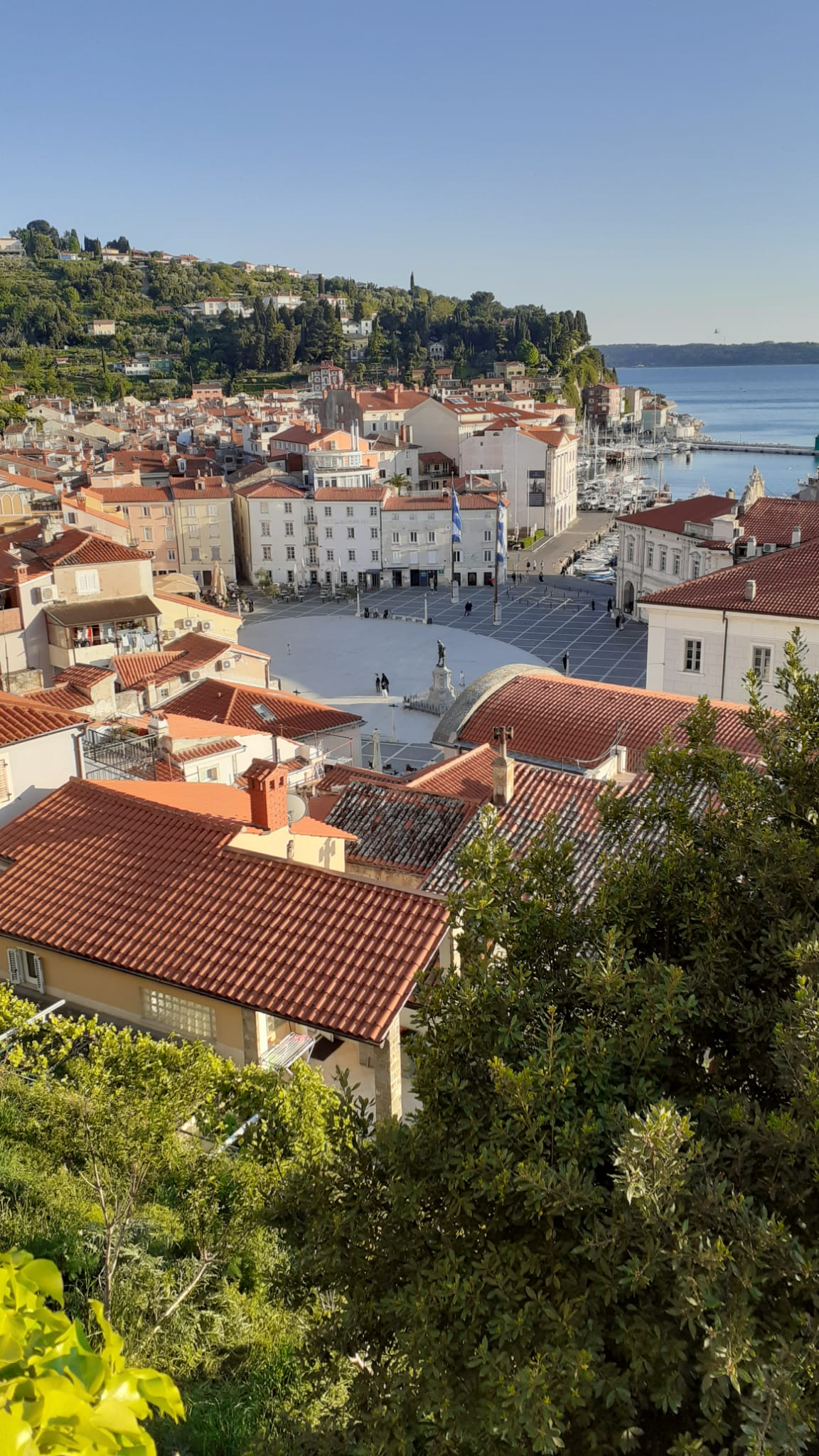


Town and Sea, Urban Form and Memory
Piran
Piran emerges as a meeting point between urban fabric and sea. At its centre, Tartini Square appears as an extension of the waterfront, as if the sea itself had become urbanised; the arc of the elliptical pavement recalls a wave entering the town. The monument to Giuseppe Tartini gives symbolic focus to the square, embodying the cultural identity and historical memory of Piran. Positioned along the axis between sea and town, it appears almost to float between them, mediating between civic space and the maritime horizon.
From the elevated viewpoint, the topography of the town is revealed through cascading roofs and streets descending toward the harbour, emphasising Piran’s adaptation to the hillside and its dense Mediterranean urban character. Although absent from view, St. George's Parish Church remains implicitly present behind the observer. The church anchors the perspective and recalls the historical role of religious authority overlooking both civic and maritime life.
In the background, the Istrian Peninsula defines the distant horizon, framing the town between the sea and the wider landscape of the Adriatic, while recalling the maritime and commercial routes that long connected Piran to the coastal towns of Istria and the Venetian world.