14/05/26
Urban theatre
Leandro Madrazo
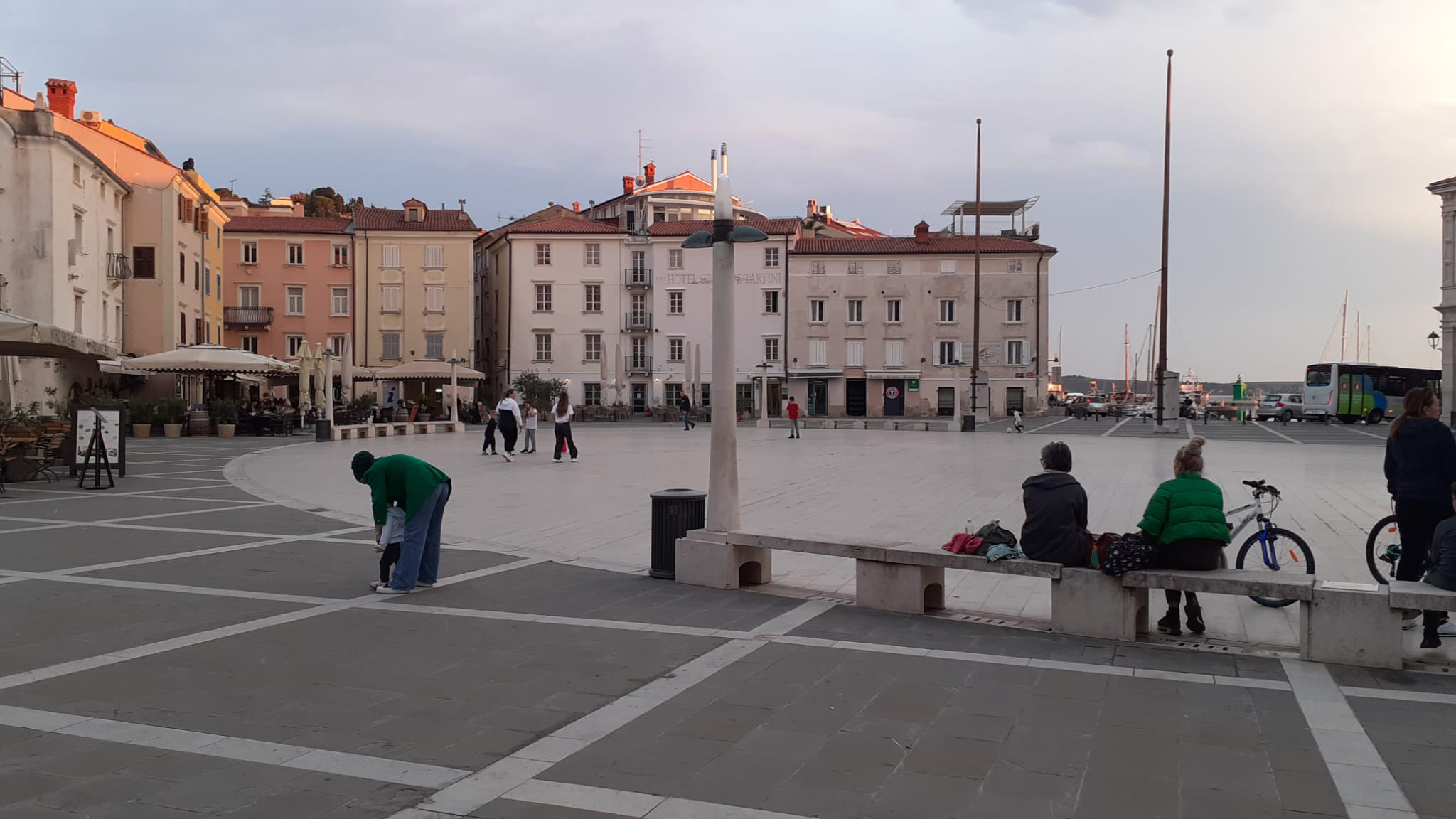
In The Concise Townscape (1961), Gordon Cullen understands public space as a place shaped through the relationship between centre, edge, movement, and perception. Tartini Square appears as an enclosed civic stage defined by the continuous façades surrounding it, while remaining visually open toward the sea and the horizon line. The contrast between the dense architectural border and the expansive paved surface creates what Cullen describes as “exposure and enclosure” — a spatial tension that gives emotional character to urban space.
People crossing the open centre of the square appear exposed within the large civic void, while others seated along the perimeter occupy positions of observation and retreat. The benches along the edge act as thresholds between participation and spectatorship, turning the square into what Cullen might describe as a “drama of juxtaposition.” The open pavement becomes a field of movement and encounter, while the architectural edges provide containment, orientation, and visual continuity.
The spatial arrangement of the square heightens the observer’s awareness of position within the environment. From the foreground benches to the distant harbour edge, the viewer experiences depth, direction, and orientation through the positioning of bodies and built elements. The paving lines guide movement across the square toward the waterfront, while the vertical poles and surrounding façades establish rhythm and spatial order.
The foreground seating area establishes the “Here” of pause and observation, while the harbour and maritime horizon form the distant “There” toward which the space opens.
14/05/26
Town and Sea, Urban Form and Memory
Leandro Madrazo
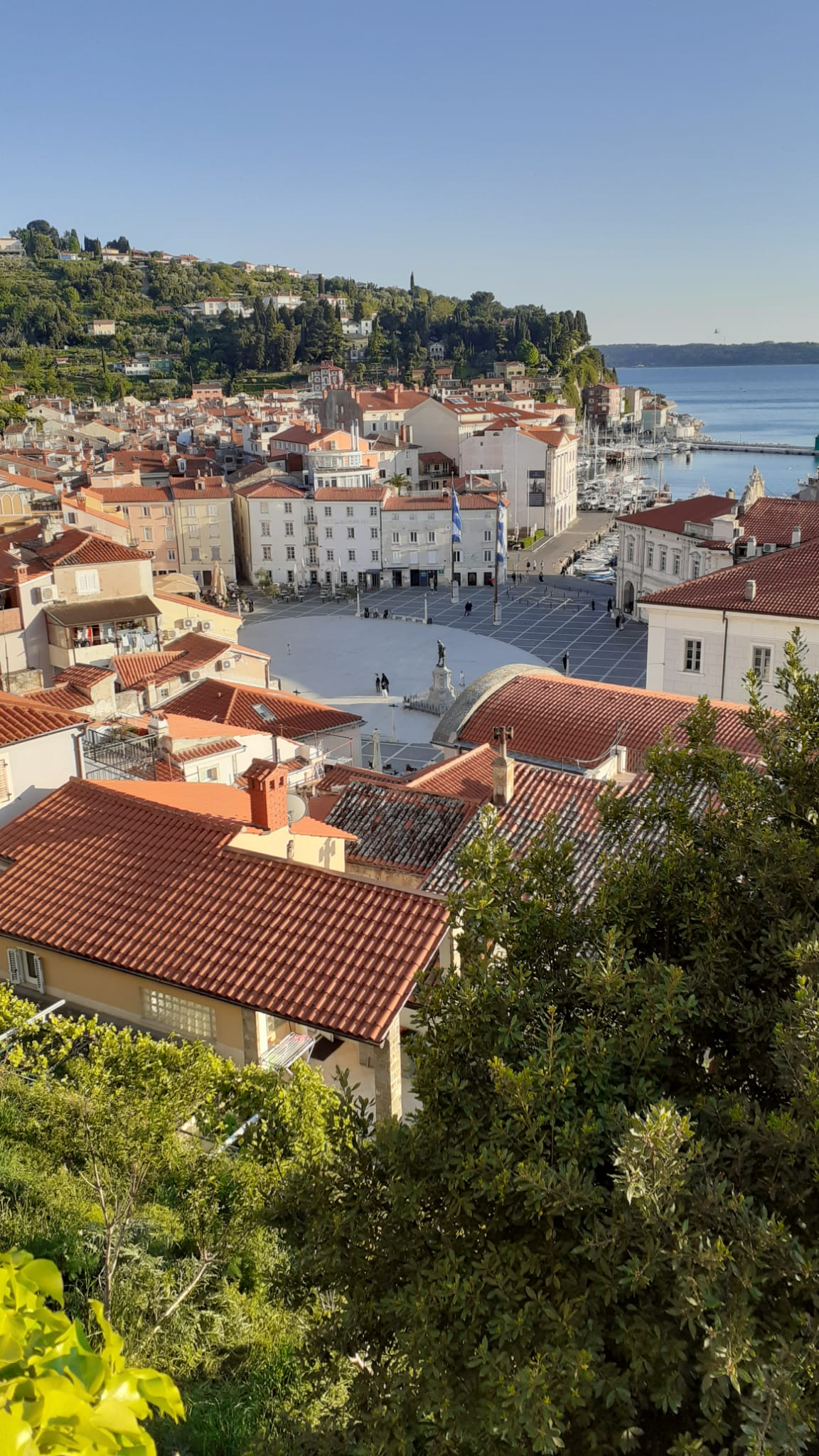
Piran emerges as a meeting point between urban fabric and sea. At its centre, Tartini Square appears as an extension of the waterfront, as if the sea itself had become urbanised; the arc of the elliptical pavement recalls a wave entering the town. The monument to Giuseppe Tartini gives symbolic focus to the square, embodying the cultural identity and historical memory of Piran. Positioned along the axis between sea and town, it appears almost to float between them, mediating between civic space and the maritime horizon.
From the elevated viewpoint, the topography of the town is revealed through cascading roofs and streets descending toward the harbour, emphasising Piran’s adaptation to the hillside and its dense Mediterranean urban character. Although absent from view, St. George's Parish Church remains implicitly present behind the observer. The church anchors the perspective and recalls the historical role of religious authority overlooking both civic and maritime life.
In the background, the Istrian Peninsula defines the distant horizon, framing the town between the sea and the wider landscape of the Adriatic, while recalling the maritime and commercial routes that long connected Piran to the coastal towns of Istria and the Venetian world.
15/06/25
Weekends by the Sea
Alicia
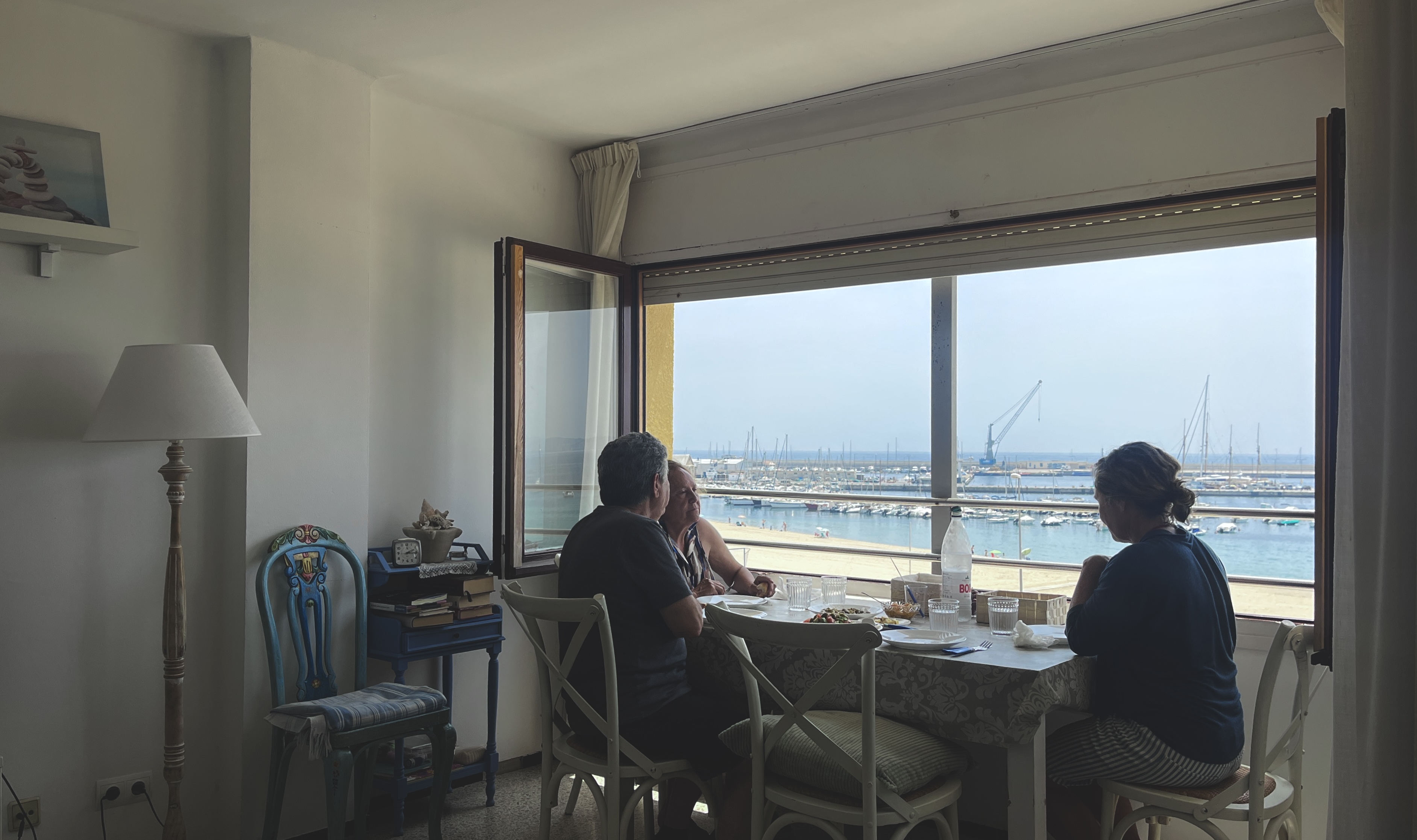
Palamós is a town on the Costa Brava, in the province of Girona. My grandparents and part of my family live there. We go almost every weekend and also spend a lot of time there in the summer. It’s a meeting point for all of us, both in winter and summer. I like it because it’s by the sea, and I love the sea. We usually have dinner at the port, where there are many restaurants and a nice atmosphere. Afterwards, we almost always get an ice cream and take a walk along the port or the promenade. It’s a place I really like, where I feel good and enjoy time with my family.
31/05/22
An ode to laundry
Nives Otaševič
I try to do my laundry at the end of every week.
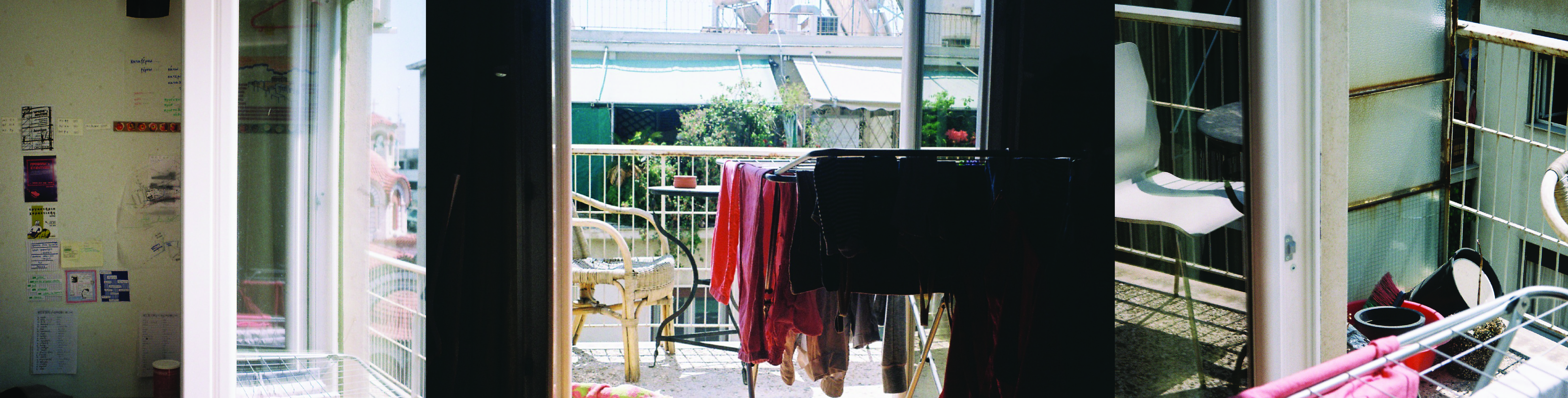
When the morning sun is touching my balcony doors, I feel motivated to do it early in the day, so the clothes and linen can get a good amount of fresh sun rays.
I can see people around putting their fresh laundry in a rooftops of apartment buildings. Probably because the awnings and the greenery on their balconies are shading them too much. Big bed linens are dancing between antennas and sun panels where they are becoming a standard part of window views.
In our balcony we don’t have an awning because our landlord is too penny-pinching, so my washings always have an opportunity to be touched by the sun, even if I leave them inside. The shadows of clothes can play freely, without interruptions by branches of greenery.
Sometimes I’m too indolent to organize washing schedule with other room-mates and I’m postponing it until I’m out of clothes to wear. In the meantime, my laundry stand is staying open for more days as it is necessary. I like the feeling of having my clothes hanging around, where they are co-living with my other small pieces. Together they are presenting my characteristics in personal, weekly changing pop-up exhibitions.
The process of doing the laundry feels like the process of communicating with neighbours. In the mornings I can hear their washing machine. I’m guessing that they are an older generation because they wake up so early, maybe they are having a siesta in the afternoon. We are talking through smells of our washed clothes being merged into each other.
I’ve done more than 50 laundries in this place, and I have around 5 of them left. The practice of doing the laundry is moving with me and through it, I become a part of a surroundings. It is hard to define my home, but wherever I’m doing my laundry, I feel like I’m able to describe it as my domestic place.
Winner of the second prize of the A-Place Mapping contest "Share your experiences of domestic places" 2022
06/06/21
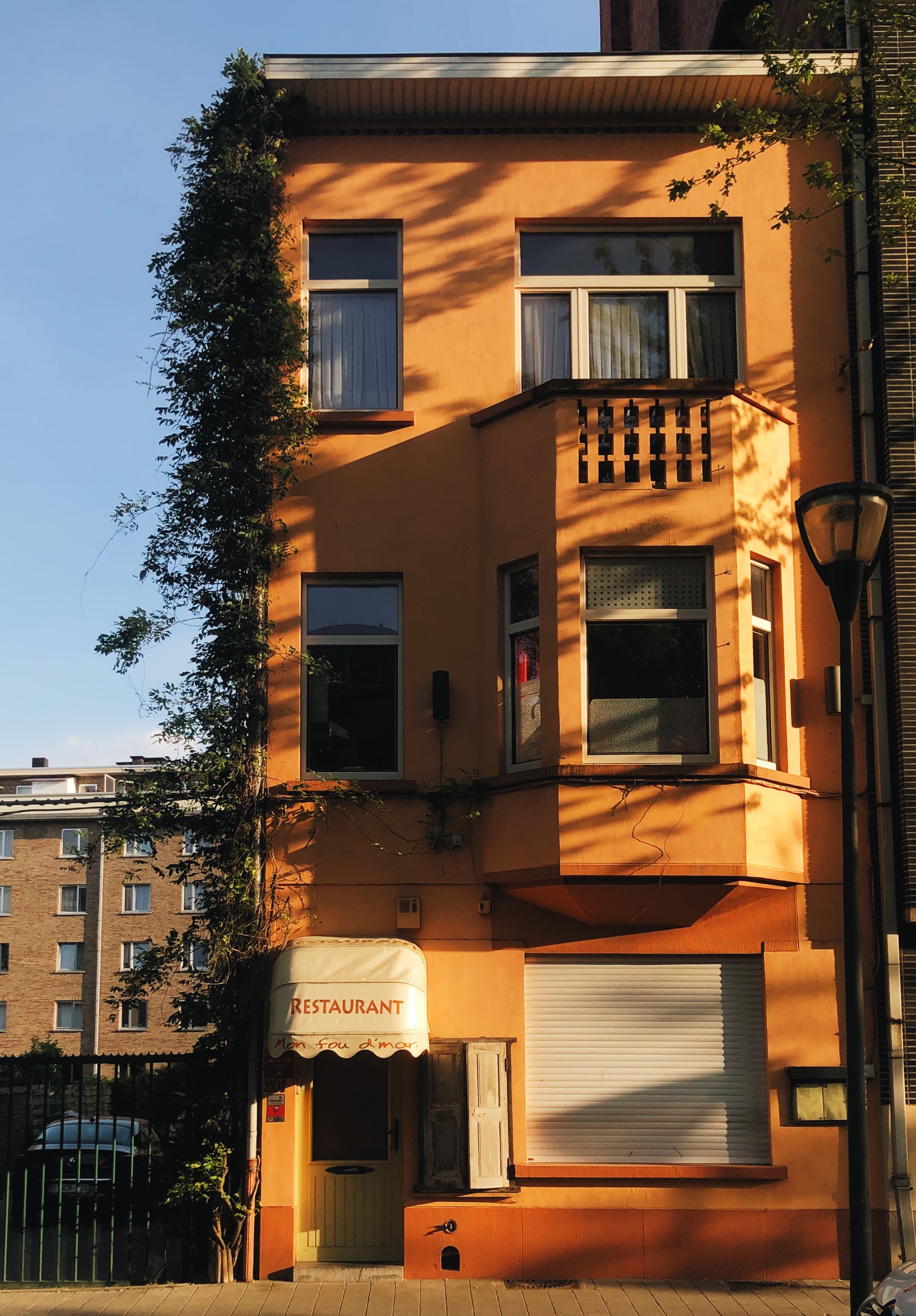
Mon Fou d’Amour
Tea Tannouri
When COVID hit, I had to move from where I lived since I couldn't afford rent anymore, so after staying at this new place I needed to discover the new area, the small Mediterranean in me was always looking for a raise of sunlight in something that would remind me of home, in this ghostlike town that the area became due to the pandemic and there it was! Warm, colorful and orange!
Winner of the first prize of the A-Place Mapping contest "Share your experience of places" 2021